CRYSTAL PET ACCESSORIES & MATCHING JEWELLERY · WHOLESALE
Blog / Wholesale Buying
Wholesale Buying · BUYER GUIDE
How to Build an Owner-and-Pet Assortment for Your Store
Plan coordinated collars and adult bracelets with clear style references, fit requirements, sample checks and a quotation brief using GK-100603.
Gem & Kin · 14 October 2026
In this guide
- The key insight: merchandise the pair, but control inventory by piece and fit.
- Build a clear pairing before expanding the range.
- Define a role for each selected style.
- Use GK-100603 as a worked selection example.
- Plan the size mix from your own customers.
- Compare complete samples before committing.
- Use a sample gate before setting the final order mix.
- An illustrative stock sheet shows why separate tracking matters.
- Ask for a quotation that separates the pieces.
- Agree what happens when a component changes.
- Keep merchandising and purchasing connected.
- Questions buyers ask about owner-and-pet collections.
Buyer takeaway: Merchandise the coordinated look, but plan stock by individual piece and fit. Separating collar sizes from bracelet requirements makes sample approval, quotations and replenishment clearer without assuming every customer wants a fixed one-to-one set.
The key insight: merchandise the pair, but control inventory by piece and fit.
The visual pairing is a merchandising idea; the purchasable units are still the individual pieces and their sizes. Keeping those two levels distinct is the most useful starting point for an owner-and-pet assortment. It allows your store to tell one coherent style story while responding to different collar sizes, bracelet fit requirements and buying patterns.
A customer may want a collar without a bracelet, two bracelets with one collar, or a matching look for pets with different neck measurements. A rigid one-collar-one-bracelet stock model can hide that demand. Present the pairing clearly, then record exactly what the customer selects. This is a stock-planning recommendation, not evidence that any particular combination will sell best in your market.
Build a clear pairing before expanding the range.
An owner-and-pet collection is easier to buy when the relationship between the two pieces is obvious: a shared colour palette, repeated beads or coordinated hardware. For a first assortment, choose a small group that your team can explain, photograph and replenish. A large number of similar options can make it harder to tell which piece or size a customer is requesting.
Start with one display story and a written selection sheet. Separate the pet collar from the adult bracelet even when they appear in the same photograph. Each needs its own quantity, fit requirement and confirmed selling description. A matching image does not by itself establish a combined wholesale price.
Define a role for each selected style.
Before adding another colour, write one sentence explaining its role in your store. A style might introduce the owner-and-pet concept, offer a darker palette for an existing display, or provide a seasonal accent. If two options serve the same role and are difficult to distinguish in a small image, compare samples before stocking both. The aim is a range your staff can explain without relying on a long list of similar names.
Consider the evidence behind the presentation as well as the appearance. Ask whether the collar and bracelet are actually available as coordinated pieces, whether their materials are named clearly, whether usable product photographs exist and whether the relevant dimensions are supplied. An attractive design with unresolved fit or material information can remain a sample candidate rather than becoming part of the first published assortment.
Keep the initial selection sheet compact enough to review as a whole. Show one image per pairing, the separate piece references, confirmed dimensions and open questions. This makes omissions visible before the quotation stage and gives the supplier a practical document to answer.
Use GK-100603 as a worked selection example.
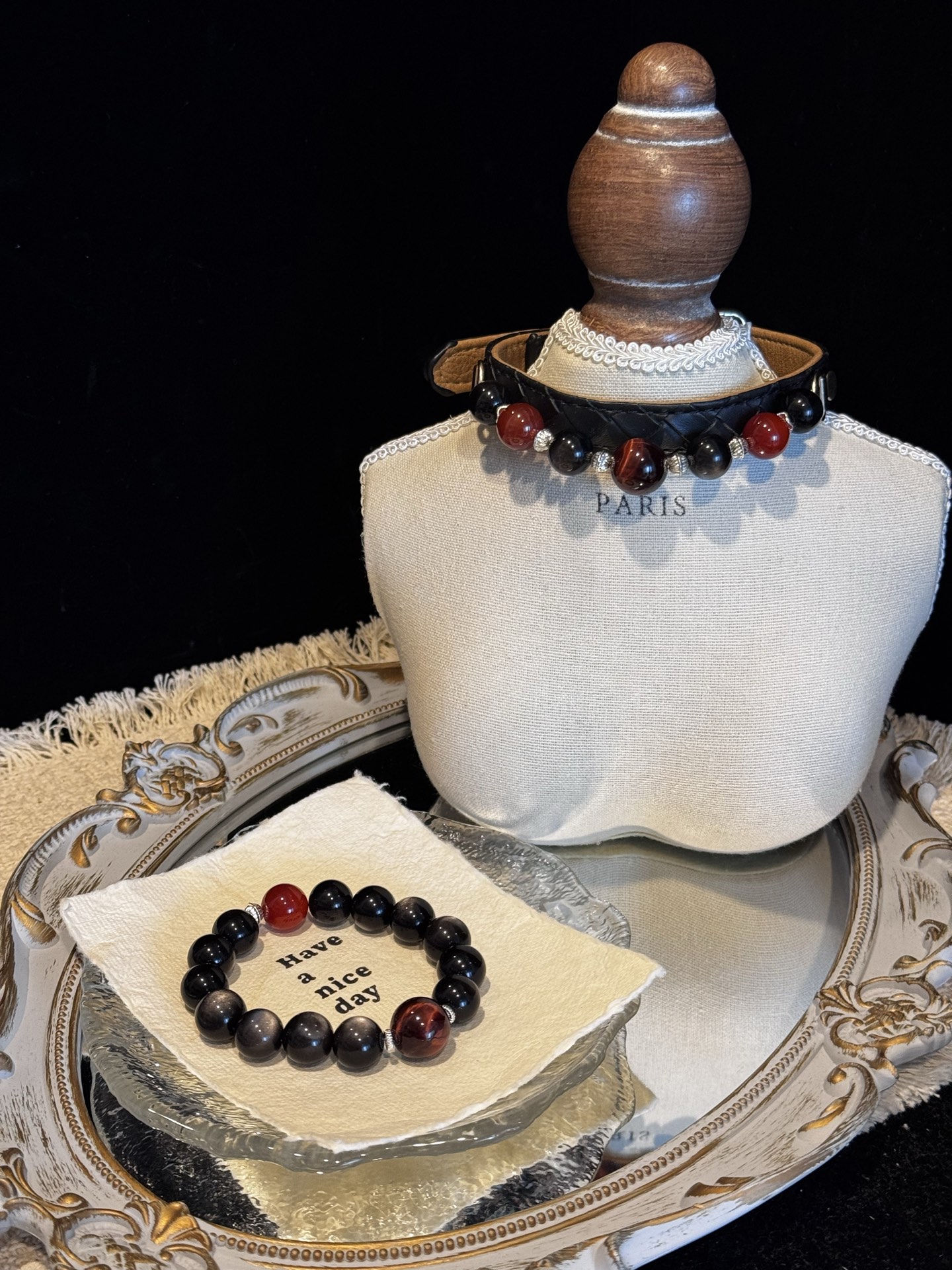
Ember Companions — GK-100603 presents a red-and-black collar with a coordinated adult bracelet. The supplier lists red tiger’s eye at 14 mm, red agate at 12 mm and silver-sheen obsidian at 12 mm for both pieces, with alloy findings. These are supplied specifications, not a claim of independent laboratory identification or untreated material.
This pairing gives a buyer a concrete way to compare the pieces while keeping the buying decision separate. You can enquire about collars, bracelets or both. Confirm the exact sample and any documentation requirements before approving your assortment.
| GK-100603 collar size | Listed neck range | Collar width |
|---|---|---|
| S | 27–32 cm | 1.5 cm |
| M | 29–36 cm | 2.0 cm |
| L | 34–44 cm | 2.5 cm |
These supplier-listed ranges describe collar fit, not bead diameter or total strap length. The finished bracelet circumference has not been supplied and must be confirmed before quotation.
Plan the size mix from your own customers.
Use your store’s customer measurements, prior size requests and sample feedback to decide which collar sizes to request. Do not infer fit from a breed label or from the appearance of a display mannequin. Ask about finished weight, adjustment, closure and the complete construction as well as neck range.
For the bracelet, give the intended wrist measurement and preferred fit. Larger beads affect how a bracelet feels, so bead diameter is not a substitute for trying the finished sample. Avoid advertising one universal wrist size when that dimension has not been confirmed.
Record quantities for each collar size and the bracelet separately. If customers buy more collars than bracelets, your reorder should reflect that mix rather than force a one-to-one ratio. Available minimums and replenishment arrangements are confirmed for the actual selection.
Compare complete samples before committing.
A useful sample review covers the whole accessory. Compare bead arrangement and colour in ordinary light, inspect the base and findings, and check the dimensions against the written specification. For a coordinated display, place both pieces together and decide whether the level of variation is acceptable for your store.
Keep a photograph and written notes with the approved reference. Ask how material substitutions or discontinued components will be communicated. When planning pet jewellery, confirm intended use and care instructions; do not assume a beaded strand is a load-bearing leash attachment or that a closure has a breakaway function.
Use a sample gate before setting the final order mix.
Choose what each sample must demonstrate before it arrives. For a collar, that may include the usable adjustment range, the width, the complete weight, the closure operation and how the decorative strand is attached. For a bracelet, include the finished circumference, the feel of the beads and the intended fit. Also review the actual colour relationship when the two items sit side by side.
Separate observations from acceptance decisions. “The supplied sample measures this way” is an observation. “This fit is suitable for the customers we intend to serve” is your buying decision. Record both so a later discussion does not confuse a correct measurement with a guarantee that it suits every wearer.
Do not approve a display image as a substitute for a finished sample when fit or construction is important to your range. Request the additional detail that resolves the question, and keep the order provisional until the required information is available. A smaller confirmed assortment is easier to launch accurately than a broad range whose size and component questions remain open.
An illustrative stock sheet shows why separate tracking matters.
Imagine a store reviewing twelve collar units and six bracelet units for one coordinated style. These numbers are only a planning example; they are not Gem & Kin minimums, a demand forecast or a recommended opening order. Divide the collars by the intended size mix, keep the bracelets in a separate row and note any fit options still awaiting approval.
After the first selling period, suppose the store has sold five collars but only two bracelets. A pairing-level total would conceal the imbalance. Piece-level records show that replenishment should be discussed separately, and collar-size records show which fit was actually requested. Before ordering more, look at enquiries and unavailable-size requests as well as completed sales: an item that was absent from stock could not be purchased.
Also record whether customers selected both pieces in the same purchase. That observation can help decide how much display space to give the pairing. Avoid treating a small early sample as proof of a lasting market trend. Use it to formulate the next purchasing question, then update the assortment after more evidence accumulates.
Ask for a quotation that separates the pieces.
A clear enquiry helps avoid a quote based on the wrong size mix or an assumed set. Send the information below, leaving genuinely undecided items open for discussion rather than copying a guessed specification.
- Store or business name and delivery country/postcode.
- Style reference GK-100603 and whether you need the collar, bracelet or both.
- Collar quantities by S, M and L; bracelet quantity and wrist requirements.
- Sample needs, material-document requests and any packing requirements.
- Target delivery date and any information your team still needs before approval.
Illustrative brief: “Please quote GK-100603 collars by the attached size quantities and quote adult bracelets separately. Confirm finished bracelet fit, sample availability, packing, replenishment and shipping to our postcode.” This is an enquiry format, not a minimum-order or lead-time promise.
Agree what happens when a component changes.
A matching range depends on coordination over time. Ask whether the supplier will flag changes in bead material, diameter, shade, fittings or base construction before sending a replenishment. Keep an approved sample or a clear reference record available for comparison. If a change alters the product description, review the description before offering the new version under the same retail listing.
Clarify packing by piece, labelling and whether the collar and bracelet can be identified easily when unpacked. Ask for a quotation that specifies the exact selection and any assumptions. Confirm availability and shipping for the destination you provide; domestic fulfilment arrangements do not automatically establish an overseas delivery service.
Use your order brief to record pending decisions, rather than filling gaps with presumed defaults. If the bracelet’s finished size is still unknown, make its confirmation a condition of sample approval. If a particular document or retail label is needed, raise it before the order is finalised.
Keep merchandising and purchasing connected.
Use the same style reference on your selection sheet, approved photographs, shelf label and reorder request. If you sell the pieces individually, make that clear beside the paired display. If you decide to offer a retail bundle, calculate it using the actual quoted pieces and your own costs; the supplier photograph is not a bundle price.
Track which sizes are requested, which pieces are bought together and which questions slow a purchase. That record gives you a practical basis for the next order. Expand the palette after the initial samples, fit information and replenishment process are clear.
Explore the owner-and-pet selection or read the wholesale process before sending your shortlist.
Questions buyers ask about owner-and-pet collections.
Do I have to purchase equal numbers of collars and bracelets? State the quantities you want for each piece and ask for confirmation. The photograph shows coordination; it does not define an order ratio. Available minimums are determined for the quoted selection.
Can one style reference describe both pieces? Yes, provided the enquiry also names the piece. For GK-100603, specify “pet collar,” “adult bracelet,” or both, and add the quantity and fit details. Keep that distinction in your own inventory record.
Can I choose collar size from the pet’s breed? Use the actual neck measurement and the confirmed product size range. A breed label alone does not establish the fit of an individual animal. Review the complete sample and intended use.
What is the most useful first enquiry? Send a small, clear shortlist with piece quantities, collar sizes, bracelet fit requirements, destination and sample or documentation requests. A complete brief is more actionable than a message asking for the price of every item in an album.
WHOLESALE SUPPORT
Turn your notes into a clear enquiry.
Share your shortlist, quantities and destination. Samples, documentation and packing are confirmed for the pieces selected.